Source basis
The genealogical facts are based on a source-referenced ancestry report and the church-register entries evaluated there. Motives and causes not stated directly in those records are interpreted narratively in the audio story.
Season 2 · Episode 2 · G16 · The Friemanns in Essen-Steele
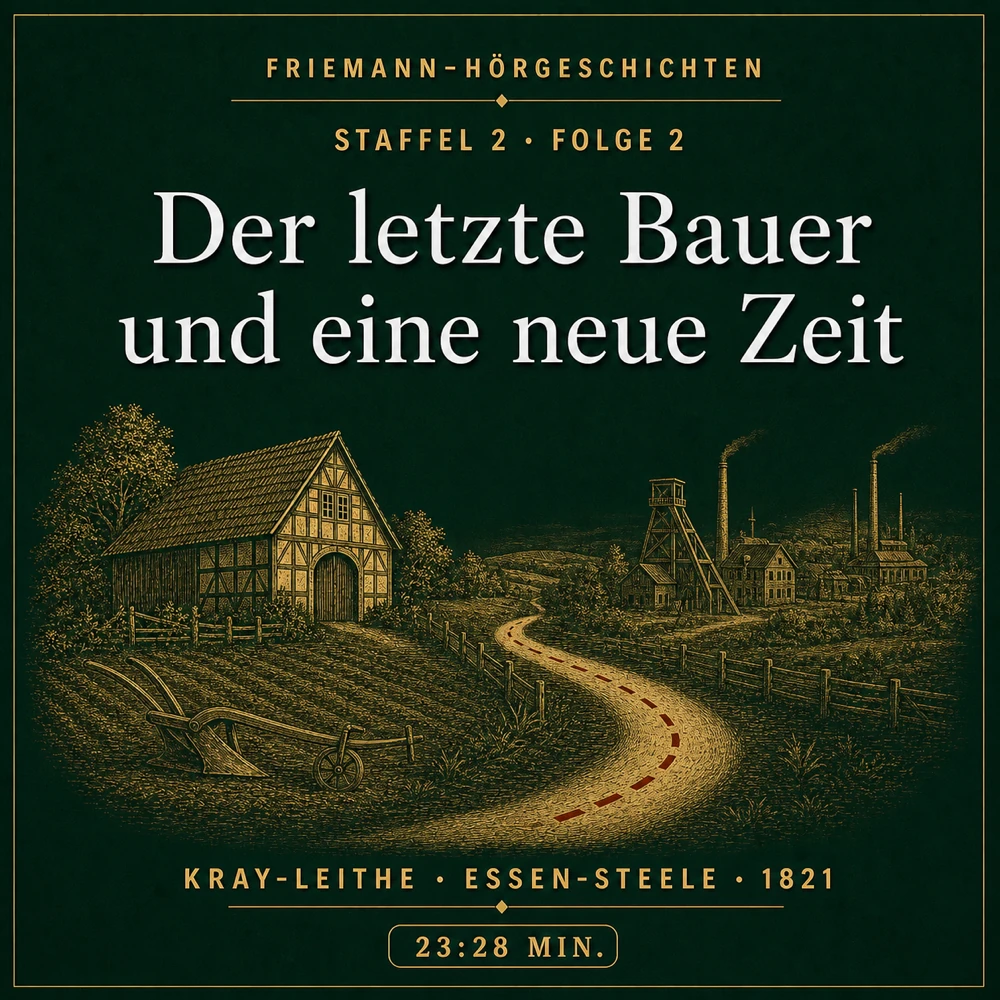
A late farm succession between the Napoleonic era, rural life, and the emerging transition to mining. The episode is spoken in German; this page provides English context and source information.
Narrative note: This audio story combines documented people and genealogical facts with historical context and narrative reconstruction. Where personal motives, conversations, or specific reasons for decisions have not survived, possible developments are interpreted from the circumstances of the time and condensed for narrative purposes. These passages are an approach to the history, not a literally documented account.
About this episode
A late marriage connects the history of the Schulte Ising farm with the family’s subsequent path to Steele.
Johann Heinrich Georg Friemann, known as Schulte Ising, married Anna Gertrud Plümer in 1821. Their son Johann Heinrich was born in 1822, during a period of profound political and economic change.
Context: The couple is presented as the second of six generations in the Essen-Steele chapter. The documented genealogical facts and further sources are provided there.
Go to this generation in the Essen-Steele chapter →The narrative form condenses the material. The documented research and its sources remain authoritative for genealogical details.
Key facts and family background
Johann Heinrich Georg grew up on the Schulte Ising farm in Kray-Leithe. His marriage to Anna Gertrud Plümer and the birth of their son mark the family story’s transition to Essen-Steele.
Basis: a source-referenced ancestry report and its evaluated church-register entries 1763/18, 1821/10 and 1824/51
The genealogical facts are based on a source-referenced ancestry report and the church-register entries evaluated there. Motives and causes not stated directly in those records are interpreted narratively in the audio story.
Recognize a clue?
If you recognize people, places, or events, we would be pleased to hear from you.
Contact us