Friemann
← Back to Family BranchesFrom the Glass Furnace
The Runge Family · maternal line
From the Glass Furnace
to the Ruhr Region
Four generations preserved a demanding craft and carried it from the Paderborn region into the industrial world of Essen-Steele.
Westphalian glassmaking tradition and the Wisthoff glassworks · historical reconstructionA craft across generations
Fire, breath, and experience
Glass was made not only from raw materials, but from knowledge passed down through generations.
The known Runge line begins in Westphalia’s glassmaking world. Johann Christoph Runge worked in Neuenbeken near Paderborn, an old center of the craft. His son Heinrich Karl and grandson Heinrich Carl remained in the trade.
With Heinrich Carl, that experience reached the Ruhr region. In Essen-Freisenbruch he first appears as a glassworker, later as a glassblower and glassmaker. A preindustrial traveling craft thus became part of the new urban world of work.
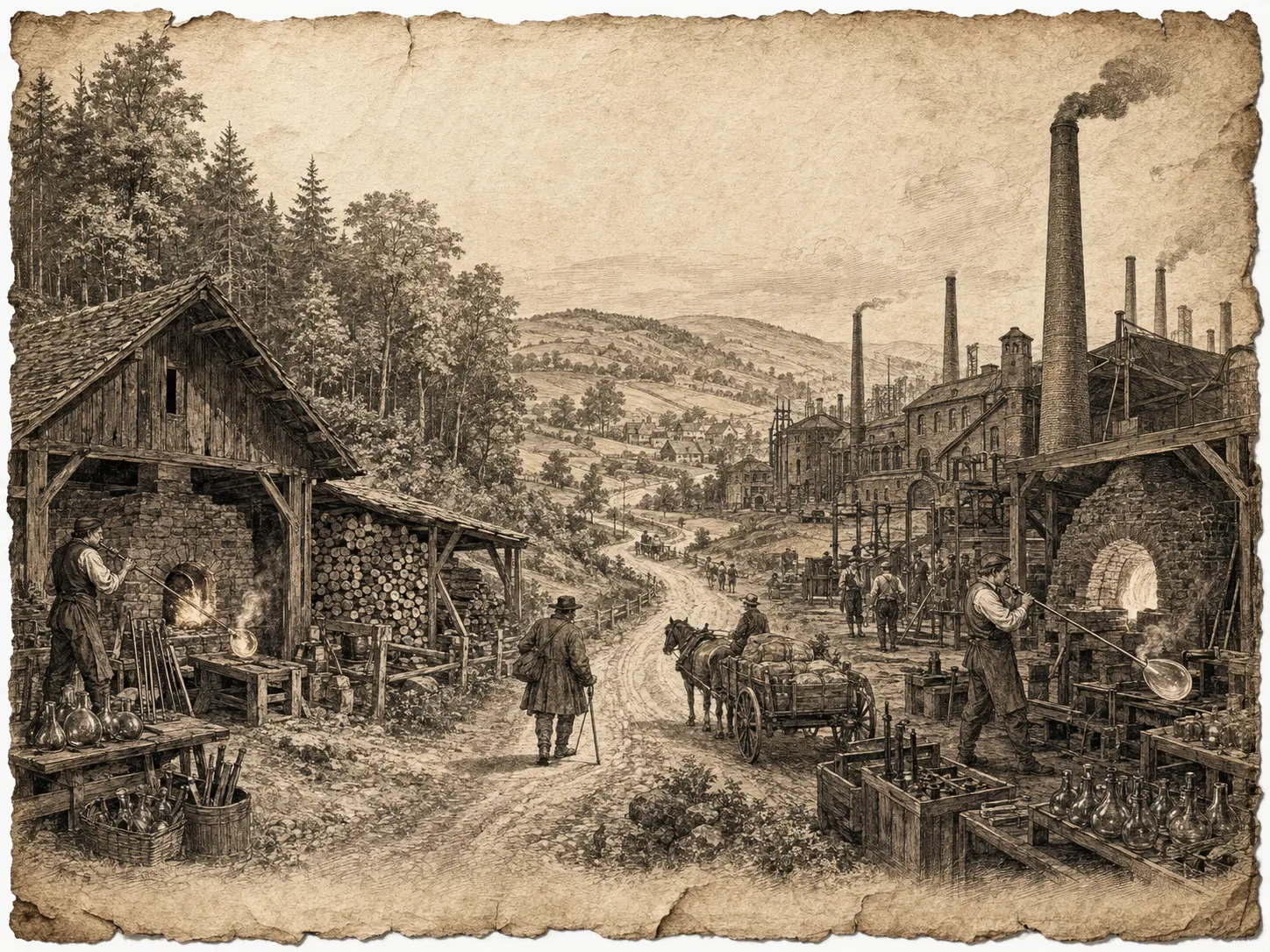
Three geographic phases
From Westphalia to Essen
Until the mid-nineteenth century, the family’s known locations lay in the Duchy of Westphalia, Schlangen, and Neuenbeken. Glassworks required large amounts of wood and were therefore often situated in forested areas.
Between about 1850 and 1900, the center of family life shifted to Essen-Freisenbruch, Steele, and Königssteele. During the twentieth century many descendants remained in Essen and nearby communities, including Mülheim, Neviges, and Gütersloh.
The occupational line
Four generations in glass
The recorded occupations reveal remarkable continuity. At the same time, the workplace changed: the small forest glassworks gave way to the industrial glass factory.
- 01Johann Christoph Rungeglassmaker in Neuenbeken near Paderborn
- 02Heinrich Karl Rungecontinued the Westphalian glassmaking tradition
- 03Heinrich Carl Rungeglassworker, glassblower, and glassmaker in Essen-Freisenbruch
- 04Caspar Hubertus Alois Rungeglassblower at the Wisthoff glassworks from 1903
A marriage through a century of upheaval
Alois and Christina
Caspar Hubertus Alois Runge was born in Königssteele in 1873. From 1903 he worked as a glassblower at the Wisthoff glassworks. Work at the furnace and blowpipe demanded strength, precision, and years of experience.
He married Christina Groß on January 16, 1901. Their marriage lasted fifty years, and they celebrated their golden wedding anniversary on January 16, 1951. Alois died in 1953 and Christina in 1954. Their story reflects the solidarity of a Catholic working-class family that lived through industrialization, economic crises, and two world wars.
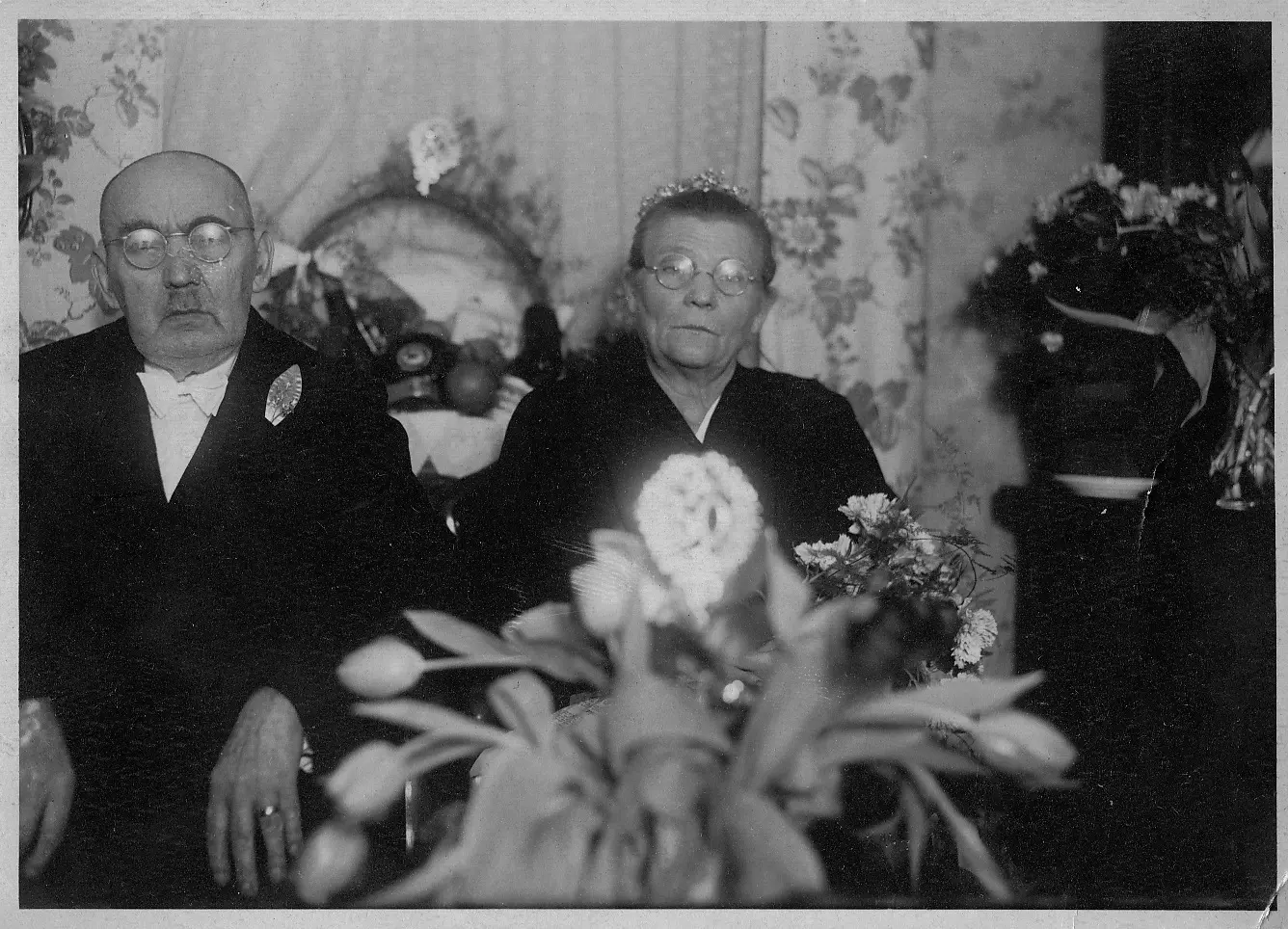
Steinhagen 6 · Essen-Steele
Eleven children under one roof
A large household, close quarters, and a dependable network of relatives, neighbors, and godparents shaped everyday life.
- 01Carl Hubertus
- 02Peter Alois Hubertus
- 03Josef Hubertus
- 04Wilhelm Hubertus
- 05Laurenz Hubertus
- 06Maria Katharina
- 07Johannes Maria
- 08Franziska Christine
- 09Gertrud
- 10Frieda Maria Elfriede
- 11Anna Luise Isabel
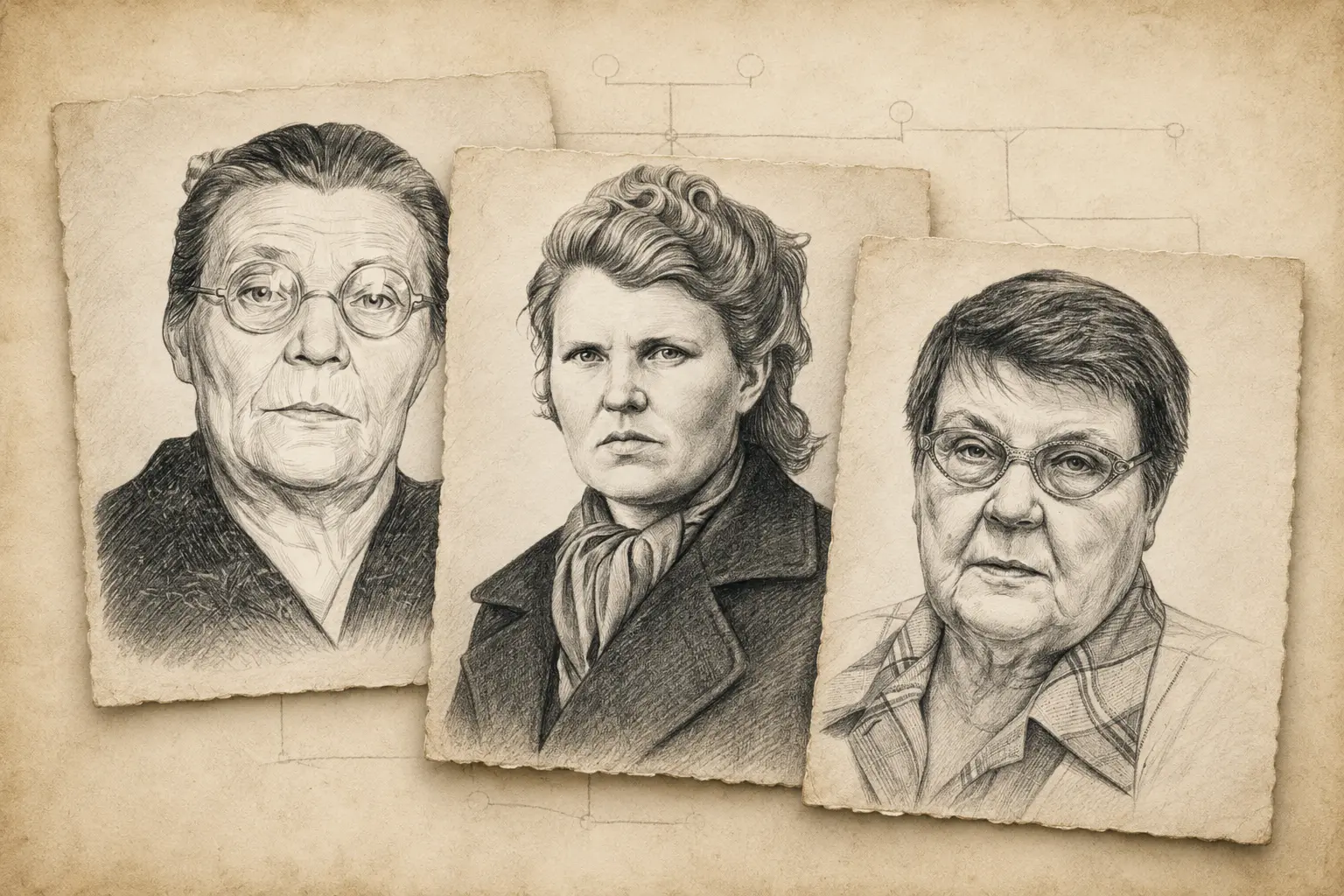
Maternal ancestors
Three generations—one maternal line
Christina Groß, her daughter Maria Katharina Runge, and her granddaughter Christine Brandt represent three successive generations connecting the Runge, Brandt, and Friemann families.
Christina and Alois Runge raised their large family in Essen. Maria Katharina married Peter Wilhelm Brandt in 1931; in 1954 Christine Brandt connected this line with the Friemann family through her marriage to Hans Willi Friemann. The path thus leads from Westphalian glassmaking through the Brandt family to Jürgen and Markus Friemann.
A clue becomes certainty
One lead reveals eleven children
A decisive source for this branch was information supplied by the Haus der Essener Geschichte/Stadtarchiv on March 8, 2021.
During our research into the Runge family, we also used the Facebook group “Ahnenforschung in Nordrhein-Westfalen” as an information resource. There we received a tentative lead concerning Christina Groß, wife of Caspar Hubertus Alois Runge. Although not adequately documented, it pointed us in the right direction for a deeper search.
An inquiry to the Haus der Essener Geschichte/Stadtarchiv provided clarity. The registration card, together with marriage and death records, confirmed the family relationships. The archival evidence showed that the marriage produced eleven children, one of whom died young.
A single uncertain name thus developed into the picture of a large family. Occupations, marriages, residences, and further descendants led into subsequent generations and connected the Runge line more precisely with the Brandt and Friemann families.
Essen’s city archive has been an extraordinarily valuable source throughout many years of our research. Its holdings and the helpful information provided by its staff have clarified numerous relationships and repeatedly opened new paths for our shared family history project. We are especially grateful.
Sources: Lead from the Facebook group “Ahnenforschung in Nordrhein-Westfalen”; written information and registration card from the Haus der Essener Geschichte/Stadtarchiv, reference 41-3-515/21; civil records, genealogical charts, the presentation accompanying Volume 2, and Family Chronicle Volume 2, especially pages 140–176. Historical context and reconstructions are identified as such.